

Ransomware Is Losing Leverage: Why Better Backups Are Paying Off in 2025
Ransomware hasn’t gone away in 2025, but it is losing its grip over targeted businesses. Total ransom payments dropped by more than a third in 2024, median payments fell by half, and recovery costs are now 44% lower than just a year ago. More than half of victim organizations fully recover within a week.
What’s behind this shift? A new generation of backup and recovery solutions mixed with tested disaster recovery (DR) playbooks. Businesses that design their systems for resilience and routinely practice restores are paying attackers less and bouncing back faster.
Let’s break down why the tide is turning, how you should strengthen your own backup and DR posture, and what questions to ask when working with IT MSPs, MSSPs or outsourced IT support in Canada, USA and Mexico.
A 30-day checklist is included to help you make immediate progress.
The Shift: Less Money to Criminals, Faster Restores for Businesses
The cybersecurity landscape is quickly evolving, and businesses are more empowered to fight back against the demands of a cyber ransom. With modern backup and recovery solutions and capabilities, the balance of power is slowly shifting in favour of businesses.
Payments Down, Recovery Speed Up: The 2025 Snapshot
The numbers tell the story. Total ransom paid globally fell from about $1.25 billion in 2023 to roughly $814 million in 2024, a 35% decline. The median ransom payment dropped 50% year over year to around $1 million. At the same time, overall recovery costs have fallen by 44%.
Even more encouraging: more than half of affected organizations now recover fully within a week. The payment rate, the percentage of victims who give in, reached a record low of about 25% in late 2024 and has hovered at 26% into 2025.
That doesn’t mean every quarter looks rosy. A handful of large exfiltration-only cases caused average payments to spike in Q2 2025. But the overall trend is clear: attackers have less leverage when victims can restore faster.
Looking for ways to strengthen resilience? Arcadion’s Backup & Disaster Recovery Services help organizations cut downtime and recover faster.
What Changed: Immutable, Air-Gapped, and Tested Backups
This shift isn’t luck. It’s the result of architectural improvements and operational discipline. Organizations are increasingly using air-gapped and immutable backups that attackers can’t encrypt or delete. More importantly, IT teams are rehearsing recovery, which means restores don’t fail when the clock is ticking.
Sophos reports that data encryption is at a six-year low, and 97% of victims whose data was encrypted were able to recover it. The lesson is simple: it’s not enough to “have a backup.” The quality of those backups and how often they’re tested determines whether you pay or walk away.
Backup Architecture That Blunts Extortion
The most effective way to remove the leverage attackers may have over you is to create a strong backup architecture and can prevent an incident from becoming a risk to your business
What Is the 3-2-1-1-0 Backup Rule?
The modern gold standard for ransomware resilience is the 3-2-1-1-0 rule:
- 3 copies of your data
- 2 different types of storage media
- 1 copy offsite
- 1 copy immutable or air-gapped
- 0 errors after verification
This framework, originally invented by photographer Peter Krogh, ensures redundancy while making it nearly impossible for attackers to wipe every copy. It’s simple in principle but requires deliberate design to execute correctly.
Ransomware incidents may be dropping, but organizations still need a recovery strategy grounded in real-world data. Our 2025 ransomware resilience insights show exactly why backups are outperforming ransom payments.
The importance of regular restore testing became even clearer after the 2025 AWS outage, which exposed how few companies truly understand their recovery point and recovery time objectives.
Need expert guidance on resilient design? Arcadion’s Business Continuity Services align backup architecture with organizational risk and compliance requirements.
Immutable Backups: Object Lock and MFA-Delete
An immutable backup is a copy of data that cannot be altered or deleted within a set retention period. Features like object lock and MFA-delete provide you with additional layers of protection against attackers who compromise admin accounts.
When ransomware strikes, immutable backups act as a safety net. Even if production systems and online backups are corrupted, immutable copies remain intact, allowing clean restores.
Network Isolation for Backup Servers
Hackers love flat networks where they can move laterally and effortlessly. Backup servers should be isolated from production systems, managed with separate credentials, and accessible only to a small set of administrators operating under least privilege.
Backup admin accounts should not live in Active Directory. This prevents attackers who compromise AD from gaining control over recovery infrastructure.
Golden-Image and Bare-Metal Recovery for Tier-0 Assets
Some systems, like domain controllers, identity providers, and financial applications, are too critical to rebuild slowly. Golden-image recovery ensures these can be rapidly reconstituted. Bare-metal restore options let teams bring Tier-0 assets online quickly, restoring business operations without extended downtime.
Recovery That Beats the Ransom Clock
Preparation is only half the battle. True resilience comes from practicing restores and proving you can meet recovery objectives under pressure.
Proving RTO/RPO with Monthly Restore Drills
Two metrics guide every DR program: RTO (Recovery Time Objective) and RPO (Recovery Point Objective).
- RTO defines how fast systems must be restored.
- RPO defines how much data loss is tolerable.
For a 200-employee company, an acceptable RTO might be 4–8 hours for core systems, with an RPO of 15 minutes to 1 hour depending on workloads.
These numbers mean nothing if they’re never tested. Monthly restore drills, often called “restore-in-anger” exercises, prove whether backups actually meet objectives.
Clean Room Restores and Malware Detonation Steps
Restoring too quickly can backfire if you reintroduce malware into production. Clean room restores into isolated environments allow teams to validate data integrity and detonate malware safely before reconnecting systems.
Tabletop Exercises and Who’s On Call
Recovery isn’t just technical. It requires coordination between IT, executives, communications, legal, and incident response teams. Regularly practiced tabletop exercises help align roles, rehearse communication, and validate offline runbooks.
From tabletop exercises to midnight server crashes- Arcadion Managed IT Support provides round-the-clock expertise, so recovery stays consistent across the board.
Business Continuity Services in Practice
Offline Runbooks and Communication Plans
When systems are down, you can’t rely on cloud docs or email. Offline runbooks, printed or securely stored offline, provide step-by-step guides. Staged communication templates for executives, regulators, and customers prevent missteps in the heat of a crisis.
SaaS Data-Export SLAs and Region Failover
More organizations rely on SaaS for critical workloads. Check whether your SaaS vendors provide export SLAs and region-level failover. Without these, your BCDR plan may have dangerous blind spots.
Incident Cost Controls: Downtime Math + Insurance
Every hour of downtime has a dollar value. Pair downtime math with cyber insurance alignment to ensure coverage actually matches business exposure. This is often where finance leaders connect with technical planning.
What To Ask Your MSP / Outsourced IT Support
Evidence Checklist for Backup Readiness
If you work with a managed service provider (MSP) or outsourced IT team, don’t just take their word for it. Ask for:
- Immutability proof
- Test logs from restore drills
- Metrics on restore success rates
Tooling Transparency and Separation of Duties
Your MSP should explain which tools they use for backup and recovery. More importantly, they should demonstrate separation of duties, meaning no single administrator has unchecked control.
Contract Clauses That Matter
Contracts should specify:
- Restore SLAs
- Breach support coverage
- Frequency and proof of tests
This protects your organization legally and operationally when an incident occurs.
Action Plan: 30-Day Backup & DR Hardening Checklist
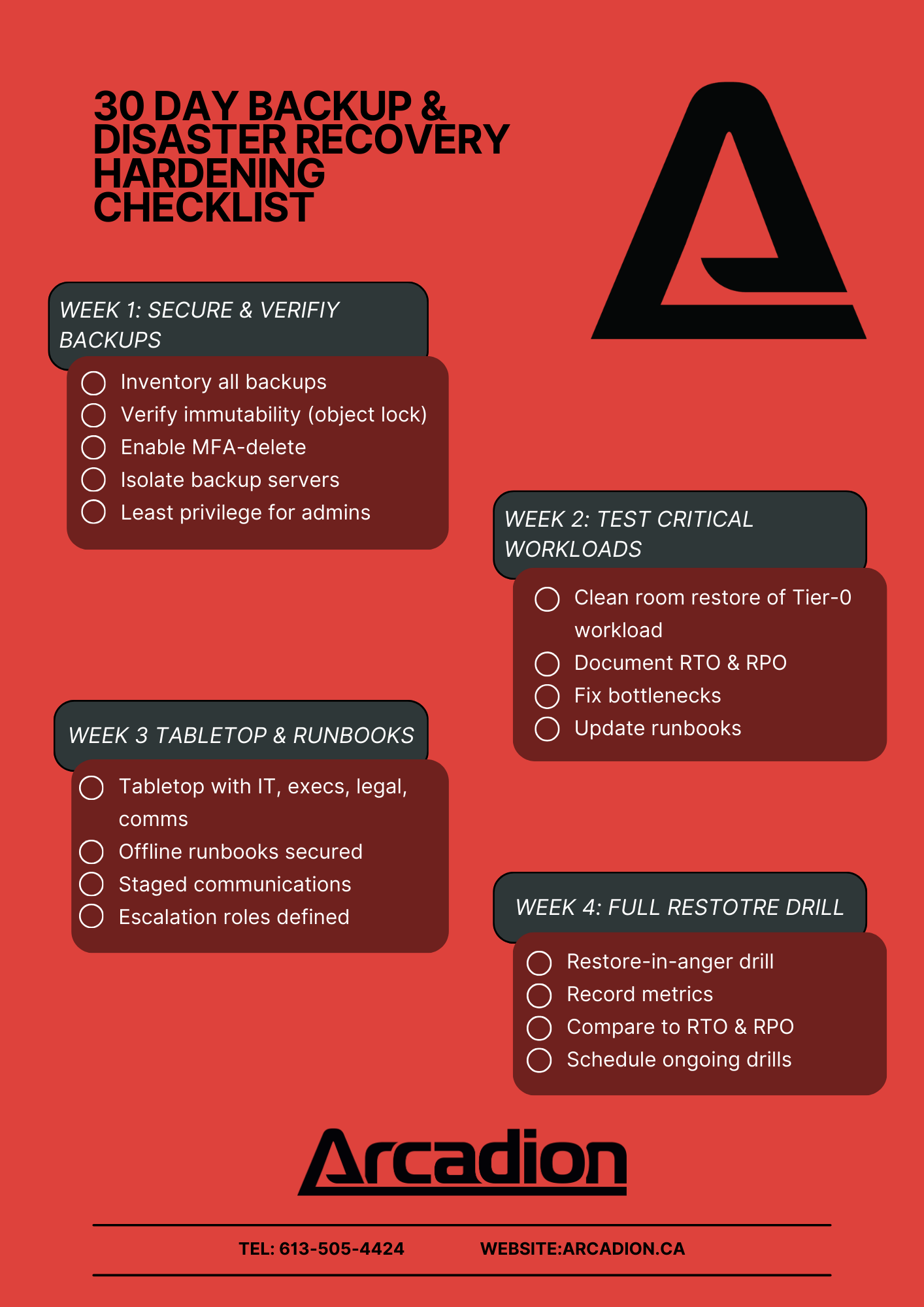
Week-by-Week Breakdown
- Week 1: Inventory all backups, verify immutability, enable MFA-delete, isolate backup network, enforce least privilege for admins.
- Week 2: Run a clean room restore of a critical workload, document RTO/RPO, and fix bottlenecks.
- Week 3: Conduct a tabletop exercise with IT, execs, comms, and legal; finalize offline runbooks; prepare staged communication templates.
- Week 4: Execute a full restore-in-anger drill, capture metrics, and schedule ongoing monthly/quarterly tests.
Metrics That Prove Progress
- Actual restore time vs. RTO target
- Data loss measured vs. RPO target
- Drill pass/fail rate and improvements over time
This 30-day plan is aggressive but realistic. Completing it means your organization is demonstrably harder to extort.
Ransomware Leverage Is Falling, But Only If You’re Ready
The data is clear: ransomware payments are trending down because businesses are investing in better backup and recovery solutions, rehearsing disaster recovery, and demanding accountability from their IT providers.
Attackers still exist, but leverage is shifting. Organizations that commit to immutability, air-gapped storage, and rigorous restore drills can recover without writing a cheque.
Book a 30-minute BCDR audit with Arcadion
FAQ: Paying Ransom, Legal, and “What If Backups Fail?”
Should we ever pay a ransom?
Law enforcement discourages ransom payments. Final decisions involve legal and insurance counsel, but every effort should be made to avoid paying.
How do immutable backups differ from regular backups?
Regular backups can be altered or deleted. Immutable backups, protected by object lock or MFA-delete, cannot be modified within their retention period.
How often should restores be tested?
At least monthly for critical workloads, with quarterly full-scale drills.
What if attackers exfiltrate but don’t encrypt data?
Backups don’t prevent data leaks. This requires layered defenses and legal/compliance response plans.
What metrics prove backup readiness to executives?
RTO, RPO, restore drill success rate, and documented improvements over time.