

How to Build Better IT Networks in 2026: A Guide for Ottawa Businesses
Most business networks in Ottawa are struggling to keep up with what companies are asking of them these days. Built for the old model of office-based users, predictable traffic patterns and neatly defined boundaries, that model has simply become outdated.
In 2026, you’ll be looking at your network to support all these new demands for hybrid work, multi cloud setup, SaaS and increasingly, those automated AI workloads which behave nothing like traditional users in the slightest. Threats are constantly evolving, invisible to the naked eye, and can cause a world of trouble before you even know they’re a problem.
But in Ottawa, specifically, there are added layers that don’t exist to the same extent elsewhere – especially in cities like Toronto or Calgary. Being close to the federal government means Ottawa companies have to navigate data sovereignty expectations, the requirements of PIPEDA and stay on top of frameworks such as the government’s Cloud Adoption Strategy, which influence how infrastructure needs to be designed.
A better network in 2026 is not about faster internet or a hardware refresh. It is about building infrastructure that is sovereign by design, ready for AI-driven workloads, and continuously managed and secured. Not patched on a schedule.
What Building a Better IT Network Actually Means in 2026
A strong network is no longer just about connectivity. It’s also about how well it supports business operations under pressure, at scale, and under regulatory scrutiny.
From Traditional Networks to Modern Network Architecture
Traditional networks were built around a simple idea: keep everything locked down inside, barricade the perimeter, and then react when something breaks and causes trouble
But Modern Enterprise Networks operate on a totally different model now. Data is moving back and forth all of the time – between on- site systems, cloud systems, those SaaS tools and even with external partners. And users are no longer tied down to a physical office – in many cases, they’re either not human at all, or at least they’re not interacting with a network the way they used to be – AI tools and automation agents are generating a steady stream of traffic that the old perimeter-based way of thinking was never designed to handle.
A modern network architecture needs to:
- Support hybrid and multi-cloud environments simultaneously
- Prioritize identity verification over location-based trust
- Deliver consistent performance across on-prem and cloud systems
- Provide real-time visibility into all traffic and activity
Businesses that continue treating their network as a static system will start feeling friction as complexity grows, and in Ottawa’s regulatory environment, that friction could carry compliance risk.
Why Most Ottawa Business Networks Fall Short Right Now
The problem with most business networks is not that they are broken. It is that they were built for a different era of business operations.
Performance drops when multiple cloud services compete for the same bandwidth. Visibility disappears once traffic crosses system boundaries. Security controls become fragmented, making consistent enforcement across environments difficult to maintain.
Automated traffic makes this worse. A single AI integration can generate hundreds of API calls per minute. That is a sustained load that infrastructure built for human-paced activity was never sized or configured to handle, and the result is latency spikes, dropped connections, and blind spots that traditional monitoring tools miss entirely.
For Ottawa businesses operating in regulated environments or serving clients with strict data handling requirements, those blind spots carry a specific kind of risk. They are not just performance issues. They are compliance exposures with real consequences.
The Three Pillars of Building a Better Network in Ottawa
A modernized network is defined by how the system is designed, not just what hardware it runs on.
1. Sovereign by Design: Canadian Data Residency and Control
For many Ottawa businesses, network design now needs to account for jurisdiction from the start, not as an afterthought.
The federal government’s direction on cloud adoption explicitly prioritizes data residency and supplier sovereignty. Organizations that work with government clients, hold sensitive citizen data, or operate in regulated sectors are increasingly expected to demonstrate where their data lives and who can access it.
That includes:
- Core data, backups, and critical workloads should reside on Canadian infrastructure, not just in a cloud region that happens to be geographically close
- Cloud contracts should explicitly define data residency, jurisdiction, and access rights. Many standard enterprise agreements do not do this by default
- Encryption key control should sit with your organization, not your vendor. If your provider manages your encryption keys, your actual level of data control is limited regardless of where the servers are located
- Supplier access audits should be conducted regularly, particularly for any vendor with US parent entities subject to CLOUD Act provisions
This is not just a compliance checkbox. It is a long-term risk reduction strategy as Canadian data protection expectations continue to be a priority.
2. AI-Ready Network Infrastructure: Built for Machine Traffic
A HUGE change in network demand right now is being driven by machine activity rather than human behaviour.
AI workloads hit networks differently than traditional traffic. A single LLM querying an internal knowledge base can generate thousands of API calls per hour. An automation platform syncing across a CRM, ERP, and cloud storage creates constant bidirectional traffic across multiple environments. A real-time security agent scanning endpoint telemetry adds persistent, low-latency demand on top of all that.
None of this was ever factored into how most QoS configurations were originally built.
An AI-ready network needs:
- Low-latency communication across both cloud and on-prem environments, consistently, not just at peak hours
- API gateway infrastructure that can handle high call volumes, enforce rate limits, and log requests for audit purposes
- Observability tooling that gives you visibility into how systems interact, not just whether they are online
- Scalable architecture that absorbs new integrations without destabilizing existing services
For Ottawa businesses adopting AI tools to improve service delivery or operational efficiency, this is where the gap between current infrastructure and actual requirements becomes visible quickly.
3. Continuous Management and Built-In Security
Reactive IT is no longer a viable model. Waiting for issues to surface before responding creates unnecessary downtime, compliance risk, and cost.
Continuous network management means the infrastructure is monitored, optimized, and secured in real time, not on a quarterly review schedule.
Security architecture should be built in from the start, not layered on afterward:
- Zero trust access models verify every connection regardless of origin. Internal users, contractors, remote staff, and automated systems all face the same verification requirements
- Network segmentation limits how far a threat can move once it is inside. A compromised endpoint in one segment should not have a clear path to your financial systems or client data
- Identity, endpoint, and network controls operate together as a unified system rather than three separate tools with gaps between them
For organizations in Ottawa with government contracts or regulated client relationships, governance matters just as much as security controls. Clear policies around what data can be accessed, where it can be processed, when human oversight is required, and how decisions are logged are becoming baseline expectations, not optional frameworks.
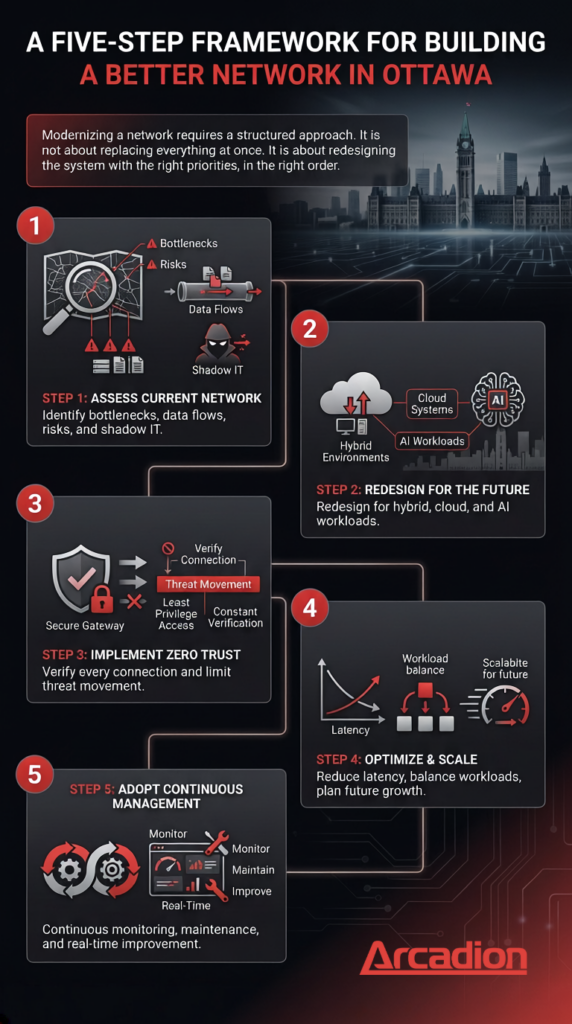
A Five-Step Framework for Building a Better Network in Ottawa
Modernizing a network requires a structured approach. It is not about replacing everything at once. It is about redesigning the system with the right priorities, in the right order.
Step 1: Assess Your Current Network Infrastructure
Before anything else, you need an accurate picture of where your network stands. This means identifying performance bottlenecks, mapping data flows between systems, and cataloguing components that may be creating visibility gaps or compliance exposure.
Many organizations discover during this phase that they have cloud services running under shadow IT, tools adopted by teams without formal IT involvement that are quietly moving data across jurisdictions outside of any governance framework.
Step 2: Redesign for Hybrid and AI Workloads
Modern networks need to support multiple environments at once. On-prem systems still play a role, but cloud platforms and SaaS tools are now central to most operations, and AI workloads add requirements that neither traditional nor early cloud architectures were built for.
This step typically involves rethinking traffic routing, establishing API gateway infrastructure, and designing for redundancy and failover across all environments, not just within a single data centre.
Step 3: Implement Secure, Zero Trust Architecture
Security needs to be embedded from the beginning. Zero trust models shift the focus from location-based trust to continuous identity verification, so every connection, whether from a remote employee, a contractor’s laptop, or an automated integration, is validated before it is granted access.
Segmentation is implemented at this stage to contain potential threats and limit lateral movement within the network.
Step 4: Optimize for Performance and Scalability
Performance issues are usually symptoms of structural problems, not bandwidth problems. Addressing them means reducing latency, prioritizing traffic intelligently, and making sure workloads are balanced across systems in a way that holds up as AI-driven activity increases.
For Ottawa organizations expecting growth in government contract volume or client data processing, scalability needs to be built in now, not retrofitted after the next capacity ceiling is hit.
Step 5: Move to a Continuously Managed Network Model
A network is not a project. It is an ongoing operational system that requires monitoring, maintenance, performance tuning, and regular updates to stay ahead of both technical failures and evolving threats.
Through a continuously managed model, organizations move from reactive environments where problems are discovered after they cause damage, to proactive infrastructure that is maintained and optimized in real time. Arcadion’s infrastructure modernization services are built around this approach, helping Ottawa businesses redesign and manage networks that can support real operational demands.
Common Mistakes Ottawa Businesses Make When Upgrading Networks
These are the patterns that cause network upgrade projects to fall short:
- Treating it as a one-time project. Networks that are upgraded and then left alone quickly fall behind. The threat landscape and compliance requirements both move faster than a two-year refresh cycle.
- Overlooking data residency during cloud migration. Selecting a cloud provider based on price or features without confirming Canadian data residency and jurisdiction terms is one of the most common compliance exposures in Ottawa organizations.
- Underestimating AI workload impact. Organizations adopt AI tools at the application layer without assessing what those tools demand from the network. The result is performance degradation and visibility gaps that appear weeks or months after the tools go live.
- Adding security after the fact. Security controls bolted onto an existing architecture are always less effective than controls built into the design. Retrofitting zero trust onto a flat network is significantly more complex and costly than building segmentation in from the start. Arcadion’s network security services are designed to embed security into the architecture from day one, rather than treating it as a separate layer.
- Choosing vendors without Canadian requirements in mind. Not every managed IT provider has experience with PIPEDA, CCCS guidelines, or the specific data sovereignty expectations that come with working in Ottawa’s government-adjacent environment.
Why Ottawa Businesses Face a Different Set of Network Requirements
Ottawa’s business environment is shaped by federal proximity in ways that do not apply to most other Canadian cities.
A significant portion of Ottawa’s private sector, from consulting firms to technology companies to professional services organizations, holds government contracts or serves clients who do. That creates a downstream obligation to meet data handling, security, and sovereignty standards that go well beyond what a typical SMB would encounter.
At the same time, AI adoption is accelerating across every sector. Organizations are integrating tools that are genuinely useful but that also create new demands on network infrastructure and new risks if governance frameworks are not in place.
The combination of stricter compliance expectations and growing AI workloads means Ottawa businesses need to be more deliberate about network design than businesses in most other markets. Getting this right is a competitive advantage. Getting it wrong carries both operational and reputational consequences.
Is Your Network Ready? Signs It Is Time to Act
If any of the following apply to your organization, your network likely needs attention:
- Frequent performance drops when multiple cloud services are in use simultaneously
- No clear visibility into traffic between on-prem and cloud systems
- Security tools that operate independently rather than as an integrated system
- Cloud contracts that do not explicitly define data residency or jurisdiction
- Difficulty adopting new AI or automation tools without degrading existing performance
- No formal governance framework for what data can be accessed by which systems
When infrastructure starts limiting growth or creating compliance exposure, the cost of inaction becomes higher than the cost of modernizing.
Book a Free IT Network Assessment for Your Ottawa Business
If your network is showing signs of strain, or if you are not sure whether it meets current data sovereignty and security standards, the right first step is an honest assessment of where things stand.
Arcadion offers a free IT network assessment for Ottawa businesses. We will map your current infrastructure, identify gaps in performance, security, and compliance readiness, and give you a clear picture of what a better network looks like for your specific environment, with no obligation.
Book Your Free Network Assessment
Arcadion provides managed IT network services and solutions for businesses across North America with a focus on data sovereignty, AI-ready infrastructure, and continuous security management.
Explore our website to learn more about our Managed IT, Cybersecurity and AI Services in Ottawa.
More related reads: