

The Call Center Is Dead. Customer Service Automation Is Here.
How AI service agents are changing customer support, call centers, and enterprise service operations by connecting directly to CRM, ERP, billing, ticketing, and workflow systems.
Every industry has one. Finance. Automotive. Telecom. Retail. Insurance. Logistics. Every sector that serves customers at scale has built some version of the same thing: a call centers, a helpdesk, a service desk, or a support queue. The names change. The architecture doesn’t.
For decades, the customer service model has operated on the same fundamental blueprint: a human answers a call or a chat, searches for information across disconnected systems, follows a script or a decision tree, escalates when they hit a wall, and closes a ticket. The customer waits. The agent toggles between tabs. The supervisor watches a dashboard that measures talk time instead of resolution quality.
That architecture is being torn down and rebuilt from the inside out. Not incrementally. Not with a better IVR menu or a faster CRM lookup. The entire operating model of customer service, across every industry that depends on it, is being re-engineered by agentic AI.
This is the next stage of customer service automation, where AI service agents move beyond scripted responses and begin supporting real customer service operations across voice, chat, ticketing, CRM, ERP, and back-office systems.
And the organizations that don’t recognize this shift for what it is will find themselves competing against companies whose service operations are faster, smarter, cheaper, and continuously improving without adding headcount.
What Is Customer Service Automation?
Customer service automation is when you use technology to handle more customer requests at a quicker pace with less manual work. Basic automated customer service will typically handle tasks such as ticket routing, answering FAQs, updating clients, and managing simple requests. A more advanced AI-powered customer service automation might use AI service agents to get accurate and relevant context from connected tools, trigger complete workflows, and escalate to humans when and if necessary. In other words, customer service automation is about helping businesses resolve their issues more quickly and more consistently while improving service delivery quality.
Keep reading this article to see why we believe that the traditional call center and its legacy automation tools have reached their limits, how AI service agents are different, where enterprise customer service automation makes sense, and what companies need to know and understand before deploying these tools.
The Universal Blueprint of Customer Service Operations
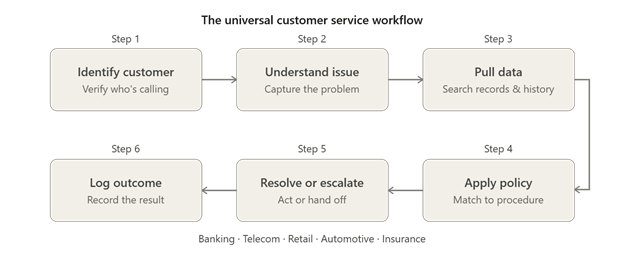
Here’s what’s remarkable about customer service infrastructure. Despite operating in wildly different industries, the underlying workflows are nearly identical:
- A customer at a bank calls about a disputed transaction.
- A customer at a dealership calls about a warranty claim.
- A subscriber calls their ISP about a connectivity issue.
- A shopper contacts a retailer about a missing order.
The surface details differ, but the operational mechanics are the same: identify the customer, understand the issue, search for relevant information, apply a policy or procedure, take an action, and follow up.
These workflows have been optimized to death within the constraints of human-operated systems. Average handle time. First call resolution. Customer satisfaction scores. Workforce management models that forecast call volume down to 15-minute intervals. The industry has squeezed every efficiency it can out of the human-in-the-loop model.
But the model itself is the bottleneck.
Human agents can only process one interaction at a time. They forget the context between calls. They interpret policies inconsistently. They burn out. Training a new agent to full proficiency takes weeks or months, and attrition rates in contact centres routinely exceed 30 percent annually. The institutional knowledge that walks out the door every quarter is staggering, and it’s never fully captured in any knowledge base.
The old-school call center wasn’t broken because people weren’t trying hard enough. This is why call center automation and contact center automation are becoming strategic priorities for enterprises that need faster resolution without simply adding more agents to the queue. It was broken because architecture demanded things that humans can’t sustainably deliver at scale: perfect recall, zero latency between systems, consistent policy application across thousands of interactions per day, and the ability to learn and improve from every single conversation in real time.
Customer service automation won’t deliver the results you expect if it only gets treated as a front end focused chatbot. It should be treated as an enterprise architecture.
Enter the Intelligent Service Layer
What’s replacing the traditional call centre isn’t a chatbot. It’s a more advanced form of automated customer service built around AI service agents, enterprise data, and workflow execution. The industry tried chatbots. Customers hated them, and for good reasons. First-generation AI assistants were keyword matchers dressed up in conversational UI. They could handle password resets and store hours. Anything beyond that, and the customer was back in a queue, now angrier than before.
| Basic chatbot | AI service agent |
| Answers FAQs | Resolves workflow-based issues |
| Uses scripts or keyword matching | Reasons across connected systems |
| Often relies on a static knowledge base | Pulls live data from CRM, ERP, billing, and ticketing systems |
| Escalates when the issue gets complex | Escalates with full context and recommended next steps |
| Measures containment or deflection | Measures resolution quality and operational outcomes |
What’s different now is the emergence of agentic AI, which are autonomous systems that don’t just respond to queries but reason through problems, access live data across enterprise systems, take actions on behalf of the customer, and learn from outcomes. This is what separates a basic chatbot from an AI customer service agent.
An agentic AI service layer doesn’t sit on top of your existing helpdesk like a coat of paint. It integrates directly into the operational backbone, which may include your ERP, your CRM, your billing platform, your inventory management system, your policy engine, and your knowledge base. It doesn’t search for answers. It synthesizes them from the source systems in real time.
This is where AI architecture and design matter. The agent will need access to data, clear workflow rules, and infrastructure that will allow it to behave reliably across customer-facing tools.
When a customer contacts an AI-powered service agent about a billing discrepancy, the agent doesn’t look up an FAQ. It pulls the customer’s billing history from the ERP, cross-references the charge against the service agreement, checks for known billing system issues in the internal knowledge base, determines whether a credit is warranted under current policy, and either resolves the issue on the spot or escalates with full context to a human specialist, all within seconds.
That’s not a chatbot. That’s a digital operations agent with enterprise-grade system access and the reasoning capability to use it.
AI service agents only work when they are connected to the right systems, data, and workflows. Arcadion helps enterprises plan and build that foundation.
Industry by Industry: The Same Customer Service Automation Shift
The transformation is playing out across every sector, each adapting the same core capability to its specific operational reality.
Across these sectors, customer support automation is following the same pattern: connect the AI agent to the right systems, give it clear operational rules, and use humans where judgment, empathy, or exception handling is required.
| Sector | What the AI agent handles | Key capability | Business impact |
| Financial services | Account inquiries, claims intake, fraud dispute resolution, compliance-sensitive communications. Insurance claims AI supports intake, status updates, documentation, and escalation. | Real-time regulatory guardrails—every response, action, and disclosure meets jurisdictional requirements | Hundreds of millions in annual efficiency gains for institutions processing millions of interactions monthly |
| Automotive (Dealerships and OEMs) | Warranty claims, service scheduling, parts availability inquiries, and and recall notifications. Dealership warranty AI connects service records, manufacturer policies, parts availability, and customer communication. | Direct connection to dealer management systems and manufacturer databases, eliminating multi-day back-and-forth | Answers in minutes instead of follow-up calls spread across a week |
| ISPs and telecom | Network diagnostics, provisioning changes, service restoration — all within the conversation. Telecom subscriber support AI draws on account data, network status, billing rules, and service history. | An issue was identified, and a fix was initiated before the customer finished describing the problem | Higher satisfaction in an industry with some of the highest call volumes and lowest CSAT scores |
| Retail and e-commerce | Order tracking, returns, inventory availability, loyalty program management. Retail customer service automation reduces repetitive tickets while creating more proactive service experiences. | Personalization from purchase history plus proactive outreach—delay notifications with revised estimates sent before the customer complains | Fewer inbound tickets and more proactive service experiences for high-volume brands |
Different industries. Same underlying transformation. The service experience is being rebuilt from the data layer up, not the interface down.
The Continuous Improvement Engine
Here’s the part that separates agentic AI from every previous wave of contact center technology: it gets better on its own.
Traditional call centers improve through periodic training refreshes, updated scripts, and quarterly QA reviews. The feedback loop is slow, manual, and lossy. An agent handles calls poorly on Monday. The QA team catches it on Friday. The coaching session is taking the following week. The behavior change might show up the week after that.
An AI service agent operates on a fundamentally different cycle. Every interaction generates structured data:
- what the customer asked
- what systems the agent accessed
- what actions it took, what the outcome was
- whether the customer’s issue was resolved
- and how satisfied they were.
That data feeds directly back into the model’s reasoning and workflow optimization.
Patterns emerge in hours, not quarters:
- If a particular type of billing inquiry is generating repeat contacts, the system identifies the root cause and adjusts its resolution approach.
- If customers in a specific region are consistently asking about a service outage, the agent proactively surfaces that information before the customer must ask.
- If a particular escalation path is producing poor outcomes, the workflow is refined.
This isn’t theoretical. This is the operational reality of AI systems that are connected to the full data pipeline of a customer service operation. The system doesn’t just handle calls. It learns from every single one.
What Enterprise Businesses Need to Get Right Before Automating Customer Service with AI solutions
The biggest risk is that your AI answers or performs an action without the right context, data boundaries, escalation rules, and accountability model. Before thinking about deploying AI service agents, enterprise businesses will need to define the following:
- Governance: What the AI can answer, what it can change, and when it must escalate
- Privacy and security: Which customer data can the AI access and how that access is controlled
- System permissions: Whether the AI can only retrieve information or also act inside CRM, ERP, billing, or ticketing systems
- Audit logs: How every AI-driven response, action, and escalation is tracked
- Human escalation: Which issues still require human review, judgment, or approval
- Model monitoring: How performance, accuracy, customer outcomes, and errors are reviewed over time
This is when businesses might want to consider exploring AI data security and governance to make AI-powered customer service safe, reliable, and accountable.
Where Arcadion Fits: Building the Solutions That Make This Real
At Arcadion, this isn’t a trend we’re commenting on. It’s one we’re actively building.
We’re developing AI-powered customer service solutions and customer service automation systems for enterprises that need more than a vendor pitch — they need architecture, integration, and operational expertise. Our approach combines our deep experience in managed IT services and enterprise systems integration with purpose-built AI agent frameworks that connect directly to the client’s operational backbone.
This is why enterprise customer service automation shouldn’t be offered as a standalone AI tool on its own. It must also consider the required architecture, systems integration, security, workflow design, and ongoing maintenance/support.
Our solutions are built to integrate existing ERP platforms, CRM systems, internal knowledge bases, and ticketing infrastructure, giving enterprises a practical path from legacy support queues to connected AI customer service agents. We’re not asking clients to rip and replace their technology stack. We’re deploying intelligent agents that operate within it, pulling live data, executing workflows, managing escalations, and feeding insights back into the business.
And we’re doing this at scale, powered by Cylix Solutions’ high-performance computing and AI infrastructure stack. Cylix provides the GPU-accelerated compute, model training and inference pipelines, and infrastructure backbone needed to deploy, fine-tune, and run AI service agents in production environments that demand low latency, high availability, and enterprise-grade security. That foundation is especially important for enterprise AI contact center and AI call centre deployments, where performance, secure data access, and reliability directly affect the customer experience.
This partnership between Arcadion’s solution architecture and Cylix’s HPC and AI infrastructure means we’re not limited by geography or industry. We’re actively building and deploying these solutions for enterprises across the Americas and into the Middle East — organizations that recognize the competitive imperative of transforming their customer service operations and need a partner with the technical depth to execute.
From a financial services firm in Toronto, modernizing its claims processing workflow to a telecom operator in the Gulf exploring autonomous subscriber support, the use cases are live, and the results are tangible: faster resolution times, higher customer satisfaction, lower operational cost, and a service layer that improves with every interaction.
Competitive Reality: Adapt or Fall Behind
This isn’t a technology trend that companies can afford to monitor from a distance and adopt when they mature. The maturity curve is accelerating, and the competitive gap between organizations that have deployed intelligent service layers and those still operating on legacy call center models is widening in real time.
The companies that win AI customer service agents won’t be the ones that replace the most people with bots, but rather the ones that empower their human agents with AI tools. But it will be the ones that redesign customer service around data-connected resolution (AI agents that understand the request, access the right resources and systems, and follow clear rules and loops in humans when needed).
The competitive gap will not come from AI alone. It will come from how well companies redesign their customer service operations around AI agents, automation, escalation, and continuous improvement.
Customers don’t grade on a curve. They compare their experience with your service operation against the best experience they’ve had with any service operation. When a competitor’s AI agent resolves an issue in 90 seconds, while your human-staffed queue takes 20 minutes and requires a callback to handle, the customer doesn’t think about the complexity of your backend systems. They think about switching.
The economics are equally unforgiving. An AI service agent operates around the clock without shift differentials, doesn’t require onboarding, doesn’t contribute to attrition metrics, and handles concurrent interactions without degradation. Organizations that deploy these systems aren’t just improving customer experience; they’re fundamentally restructuring their cost model for service delivery.
For enterprises still running traditional contact center operations, the window to begin this transformation is open but narrowing. The organizations that move now will build a proprietary advantage — AI agents trained on their specific data, tuned to their workflows, and continuously improving against their operational benchmarks. That advantage compounds over time. The longer you wait, the harder it is to close the gap.
The Big Question: What Should Stay Human?
AI can eliminate a lot of the repetitive service work we’re all accustomed to today, but that doesn’t mean it should take over every interaction. The strongest automation strategies must keep humans involved, especially if judgment, empathy, risk, or approval matters. For example:
- Sensitive complaints where tone, empathy, and context matter as much as speed
- High-value retention conversations where a poor experience could cost the business a major customer
- Complex disputes that involve policy exceptions, billing conflicts, or unclear responsibility
- Regulatory or compliance-sensitive cases where decisions need review and documentation
- Emotionally charged situations where a customer needs to feel heard, not processed
- Final approvals for refunds, credits, account changes, or actions with financial or legal impact
Automation shouldn’t be only about cost savings and eliminating employees; it is about giving human agents better context, better escalation paths, and less manual work so they can focus on critical customer service touch points where they can add the most value.
The Path Forward
The call centre as we’ve known it (rows of agents, queue-based routing, script-driven interactions, and dashboard metrics optimized for throughput over outcomes) is reaching the end of its useful life.
What’s emerging in its place is something fundamentally more capable: an intelligent service layer that reasons, acts, learns, and scales without the constraints that have defined customer service operations for the past three decades.
For enterprises evaluating call center automation, contact center automation, or broader AI customer service initiatives, the real opportunity is not just answering customer questions faster. It is connecting AI to the data, workflows, infrastructure, and governance needed to actually resolve customer issues.
Arcadion is building these solutions today. Powered by Cylix’s HPC and AI infrastructure, deployed across industries and geographies, and engineered to integrate with the enterprise systems that businesses already rely on.
If you are ready to explore customer service automation, you may want to begin with an assessment of your current environment. Arcadion can help identify which of your workflows are ready for AI service agent development, which ones need to be connected and where controls need to be tightened before deployment.
Arcadion is a managed IT, cybersecurity, and AI development firm serving North American and international enterprises. To explore how AI-powered service solutions can transform your customer operations, visit arcadion.ca or contact our team directly.