

RAG vs Fine-Tuning: Which Approach Fits Enterprise Knowledge Work?
Enterprise AI systems often need to do two very different things: work with current company knowledge and perform specialized tasks consistently. Retrieval Augmented Generation (RAG) and fine-tuning can both help, but they solve different parts of that problem.
So how do you know which approach fits your use case?
RAG is probably the stronger choice when an AI system needs access to current, private, or frequently changing information.
Fine-tuning is better suited to improving repeatable model behaviour, task performance, or specialized output patterns. In some cases, the right architecture uses both.
Prompt engineering should be part of the decision too. Before adding a retrieval system or training a model, teams should first determine whether clearer instructions, better examples, or application logic can solve the problem.
Keep reading to compare RAG, fine-tuning, prompting, and hybrid approaches, helping enterprise teams choose based on knowledge requirements, behaviour, security, cost, and long-term maintenance.
RAG vs. Fine-Tuning: The Short Answer
RAG brings external knowledge into the model at the time of the request. Fine-tuning changes model parameters using training examples. They solve different problems, but they are complementary rather than mutually exclusive.
Microsoft’s current guidance states that RAG is a fit for private or frequently changing information, while fine-tuning is a fit for changing model behaviour, style, or task performance. Google Cloud also describes RAG and fine-tuning as separate ways to specialize an application, with the choice driven by the problem and the available data.
That does not mean fine-tuning can never improve domain-specific performance or that RAG only affects knowledge. Fine-tuning can improve how a model handles a specialized task or domain. RAG can improve answer quality by adding relevant context. The practical distinction is about where the application should get changing facts and where it should learn repeatable behaviour.
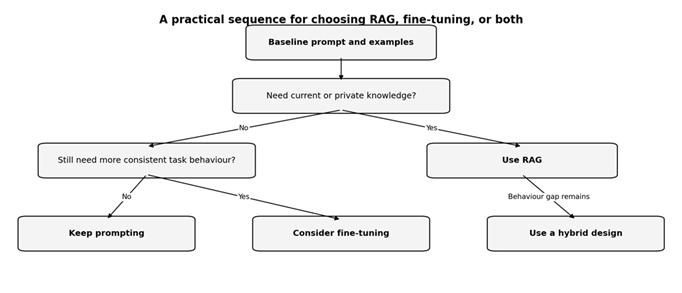
Original decision framework: start with the task, use retrieval for changing knowledge, and fine-tune only when behaviour still needs training.
Compare Four Options, Not Two
Many RAG vs. fine-tuning comparisons skip the simplest option. In production planning, the real sequence is usually prompt engineering, retrieval, fine-tuning, or a combination.
| Approach | Best fit | Fresh knowledge | Training data | Main maintenance burden |
| Prompt engineering | Instructions, format, tone, simple task constraints | Only what is placed in the prompt | Few-shot examples can help, but no training set is required. | Prompt versions, testing, model changes |
| RAG | Private, changing, traceable enterprise knowledge | Yes, when the index and source pipeline are current | No model training set required | Ingestion, permissions, retrieval quality, indexing, source freshness |
| Fine-tuning | Repeatable task behaviour, domain adaptation, structured output patterns | Not a reliable mechanism for continuously changing facts | High-quality training examples are required. | Training data curation, evaluation, retraining, model lifecycle |
| Hybrid | Applications needing fresh evidence plus specialized behaviour | Yes, through the retrieval layer | Yes, if fine-tuning is used | Both retrieval operations and model lifecycle management |
Choose RAG When the Knowledge Changes or Must Stay Traceable
RAG is generally more suitable for policies, procedures, product information, knowledge bases, research collections, internal documentation, and other sources that evolve independently of the model. The model does not have to memorize the latest policy. At request time, the application retrieves the relevant evidence and injects it into the model context. If a source is corrected, removed, reclassified, or replaced, the retrieval layer can be updated without retraining the base model.
This separation can make governance of sources and citations easier, since the application can keep track of source identifiers with retrieved chunks. RAG does not mean it is automatically accurate and secure. Poor ingestion, weak chunking, poor permissions, or quality ranking can still cause bad answers.
Choose Fine-Tuning When the Repeatable Behaviour Is the Problem
Fine-tuning changes model weights based on training examples. It can be useful when a base model repeatedly misses a specialized task pattern, classification behaviour, output format, or domain-specific style and the team has enough high-quality examples to train and evaluate the result.
A common mistake is to fine-tune because the model lacks access to current enterprise facts. Training is not a clean content-management system. Facts embedded through fine-tuning can become stale, and removing or updating a specific learned detail is much less direct than updating a governed retrieval source.
The reverse mistake is assuming RAG will fix a model that cannot follow the task reliably. If the right evidence is consistently retrieved and the remaining failure is repeatable behaviour, a carefully evaluated fine-tune may be appropriate.
Use a Hybrid Approach When Facts and Behaviour Both Matter
Some enterprise workloads need two different kinds of adaptation. The system may need current company knowledge and a highly consistent way to transform that knowledge into an output.
For example, a support assistant might retrieve current product documentation through RAG but still need consistent classification, response structure, or tool-selection behaviour. Start with RAG plus a strong prompt and examples. Add fine-tuning only if evaluation shows a persistent behaviour gap that justifies the additional training and lifecycle burden.
This sequence avoids training a model to solve a problem that better retrieval or clearer instructions could have fixed.
Three Illustrative Enterprise Decisions
| Workload | What matters most | Likely starting point | Why |
| Internal policy assistant | Current approved policies, citations, user permissions | RAG | The answer depends on changing governed documents and must point back to the source evidence. |
| Specialized request classifier | Consistent mapping into organization-specific categories | Prompting, then fine-tuning if needed | The task is behavioural and repeatable, with less dependence on changing factual knowledge. |
| Customer support copilot | Current product knowledge plus consistent response structure | RAG plus prompting, then hybrid if evaluation supports it | Retrieval handles changing facts, while tuning is reserved for proven behaviour gaps. |
Cost Depends on the Workload, Not the Label
Neither RAG nor fine-tuning is automatically cheaper. The cost model is different.
RAG makes document processing, embeddings, index storage, retrieval, reranking, extra prompt context, monitoring, and continuous source updates all pricier. When the desired behaviour or model family changes, fine-tuning increases the expenses associated with dataset preparation, training runs, evaluation, model deployment, and retraining.
Because retrieval occurs prior to creation, RAG may potentially increase delay. For some jobs, fine-tuning can shorten prompts, but if the answer depends on existing enterprise knowledge, a tweaked model may still need retrieval.
Create the comparison based on anticipated query volume, document volume, update frequency, context size, training-data requirements, model selection, latency targets, and system running costs over time. A production cost model is not the same as a demo cost.
Governance and Security Change the Decision
When the architecture is properly implemented, a RAG maintains knowledge in an external data layer that can support source-level deletion, versioning, citations, and access policies. More responsibility is transferred to training-data governance, model versioning, evaluation, and retraining as a result of fine-tuning.
Inquire about each option’s handling of source provenance, user permissions, deletion requests, auditability, model modifications, and rollback for sensitive enterprise applications. Both sides must be managed using a hybrid design. The Google Cloud comparison of RAG and tuning is a useful reference for the different specialization patterns. The specific architecture still needs to be validated against your data, risk profile, and operating model.
| ARCHITECTURE CHECKPOINT If your team is deciding between RAG, fine-tuning, or a hybrid design, Arcadion can help review the use case, data dependencies, evaluation plan, and production architecture. |
Evaluate the Simplest Viable Approach First
Before committing to an architecture, establish a baseline for comparison.
- Define the business task and the failure that matters most.
- Test prompt engineering and a capable base model first.
- If the task requires current or private knowledge, add retrieval and measure the retrieval quality separately.
- If the right evidence is available but model behaviour remains inconsistent, test whether fine-tuning improves the specific failure.
- Compare quality, latency, operating cost, governance, and maintenance against the same evaluation set.
- Use a hybrid design only when the evaluation shows a clear need for both fresh retrieval and learned behaviour.
This is where a strong RAG evaluation program becomes important. The architecture should be chosen because it performs better on the workload that matters, not because one technique is more fashionable.
A Decision Worksheet for RAG vs. Fine-Tuning
| Question | If yes, it points toward |
| Do answers depend on current, private, or frequently changing documents? | RAG |
| Should users see or verify the source behind an answer? | RAG |
| Is the main failure a repeatable task or behaviour problem after prompting has been tested? | Fine-tuning may be justified. |
| Do you have enough high-quality training examples and a way to evaluate the tuned model? | Fine-tuning becomes more practical. |
| Do you need current knowledge and stronger behavioural consistency? | Hybrid, after proving the simpler options are insufficient |
| Can the problem be solved with better prompts, examples, or application logic? | Stay simpler until evaluation says otherwise |
RAG vs. Fine-Tuning Is an Architecture Decision, Not a Feature Checklist
RAG and fine-tuning are different tools. Retrieval is usually the cleaner path for current, governed enterprise knowledge. Fine-tuning can be valuable for specialized behaviour and task performance. Prompt engineering should be tested before either one becomes more complicated than the use case requires.
The best design is the one that meets the business requirement under real data, security, cost, and maintenance conditions. Explore Arcadion’s RAG Systems capabilities if you need help validating that decision and moving from prototype to a production architecture.